
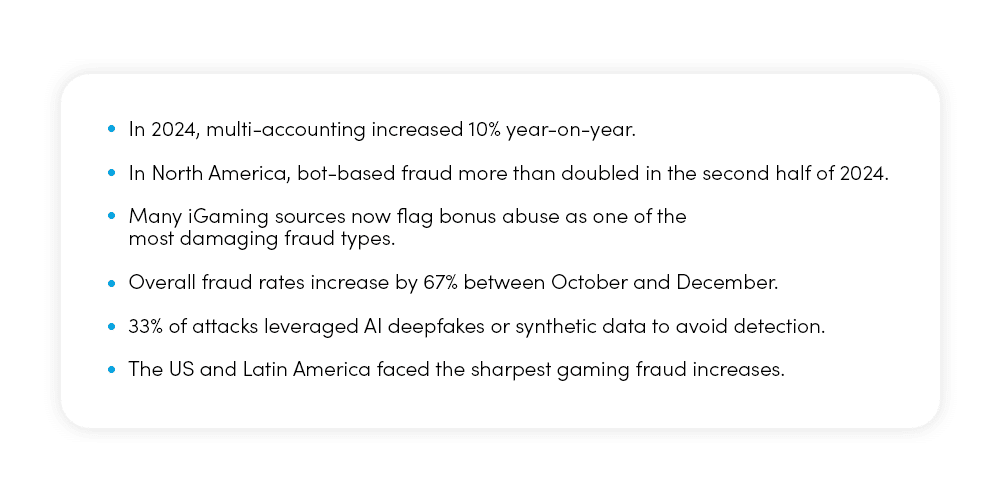
You’ve probably encountered – and are attempting to mitigate – sportsbook bonus abuse by limiting your users to single accounts, but because criminals use a layered approach to defraud your company, you’ll need a layered defense to keep your resources safe from multi-accounting. EVS is getting ahead of this topic as we approach the holiday season because multi-accounting sportsbook fraud gears up in October and spikes in November and December. Let’s make sure your online betting platform is ready for the increase in traffic by delving into current promo abuse statistics, criminal methods, and ways to stop it.
Promo Abuse Statistics: This Isn’t a Game Anymore
Multi-accounting in sports betting isn’t loud or obvious; instead, it blends into the background of your business, only raising red flags once it’s too late. Multi-accounting rings often use techniques like shared IP addresses, VPNs, bots, or even stolen identities to repeatedly benefit from your promotions. They quietly execute their activities, and they’ve already prepare their attacks weeks in advance. Reddit even has entire subreddits dedicated to teaching fraudsters how to avoid being tracked and banned for multi-accounting, leaving betting organizers scrambling to create effective barriers.
Gnoming, Arbing & VPN Spoofing Unmasked
If you frequent the sports betting world, you’ve likely heard of gnoming and arbing. These swindles grew rapidly in the mid- to late 2010s, to the point where they’re now formally recognized as significant first-party fraud.
Gnoming, used to continually claim welcome bonuses or to farm in-game resources and then syphon them into a main account, is made possible through VPN spoofing or using a shared device with a public Wi-Fi source. In extreme cases, gnomers might collude with others to manipulate entire gaming outcomes.
Arbing, short for arbitrage betting, is a scheme in which one player exploits incentives like free bets or deposit match bonuses across different gambling platforms to guarantee a profit with minimal or no risk. Arbers also open multiple accounts, often using stolen personal data, to commit multi-accounting sportsbook fraud and claim the same bonus over and over.
The Drip Effect: Why ID’ing Sportsbook Promo Abuse Is Difficult to Spot – And How You Can Do It Anyway
Promo abuse is so successful because fraudsters loosen the metaphorical gasket of your information pipeline slowly, then inject new accounts into the flow until the damage is irreversible. This might look as harmless as the same coupon code used 10, 25, or 40 times in just one day. Nothing large enough to be concerning, but certainly effective enough to drip your resources into criminals’ pockets until you’re drained.
The two most common scams are fed by welcome promotions and referral programs. First-time user promotions are fertile ground for promo abuse because your marketing team is already anticipating an increase in new accounts, and fake referrals are incredibly difficult to spot because fraudsters can simply refer themselves to collect rewards on both ends. Think your business is too big (or too small) to get snarled? The transportation giant Uber fell victim to a personal referral code scam and lost an estimated $50,000 in the process.
No business should lose thousands in revenue to promo abuse, so here’s a crash course on how to spot VPN spoofing, GPS spoofing, residential proxies, and proxy betting:
- VPN Spoofing: Masking your identity and location through a VPN is not illegal, but using a VPN to engage in malicious online activities certainly is. To reduce your risk of VPN spoofing, check suspicious IP addresses on your site for connections with known VPN providers. You can also monitor your network by using packet analysis tools to inspect your network traffic for encrypted protocols associated with VPN use.
- Residential Proxies: Though not as secure as VPNs, residential proxies also mask a user’s IP address. To locate residential proxies, compare an IP address against a database of known residential proxies, then use specialized datasets to track that IP for unusual traffic or behavior patterns.
- GPS Spoofing: GPS spoofing is made possible by GPS mockers, or applications that create false locations for a device. GPS spoofing can be identified by cross-referencing location data using stronger geolocation checks across multiple apps. Look for inconsistencies between GPS data and an IP address’s location.
- Proxy Betting: Proxy betting can be used to hide the identity of a gambler, circumvent age restrictions, or launder money. Enhance your proxy detection by watching out for VPN and GPS spoofing, as well as by tracking behavior changes like frequent, large wagers being placed by a new or low-level account.

Knowing who your platform members are is the key to stopping sportsbook bonus abuse, money laundering, and financial or reputational ruin, but that’s far easier said than done. Some brands try to stay ahead of the game by verifying identities and analyzing user behaviors, but keeping pace with criminals on your own often ends in tragedy – both for you and your customers. Instead, many of today’s online gaming and sports betting organizations are turning to professional partners for support.
At EVS, we can enhance your promo abuse detection via our BlueAssure platform and bespoke verification solutions. Not only do we tailor our offerings to your needs, but we ensure you’re always in compliance with current KYC and AML protocols. Call today for a guided tour of our BlueAssure prevention options, including AssureID and AssureLocate that are specifically designed to resolve entities across signals, quickly verify identities, build ring-probability scores, and ultimately stop sportsbook bonus abuse, all while keeping audit-ready proof of your company’s compliance.